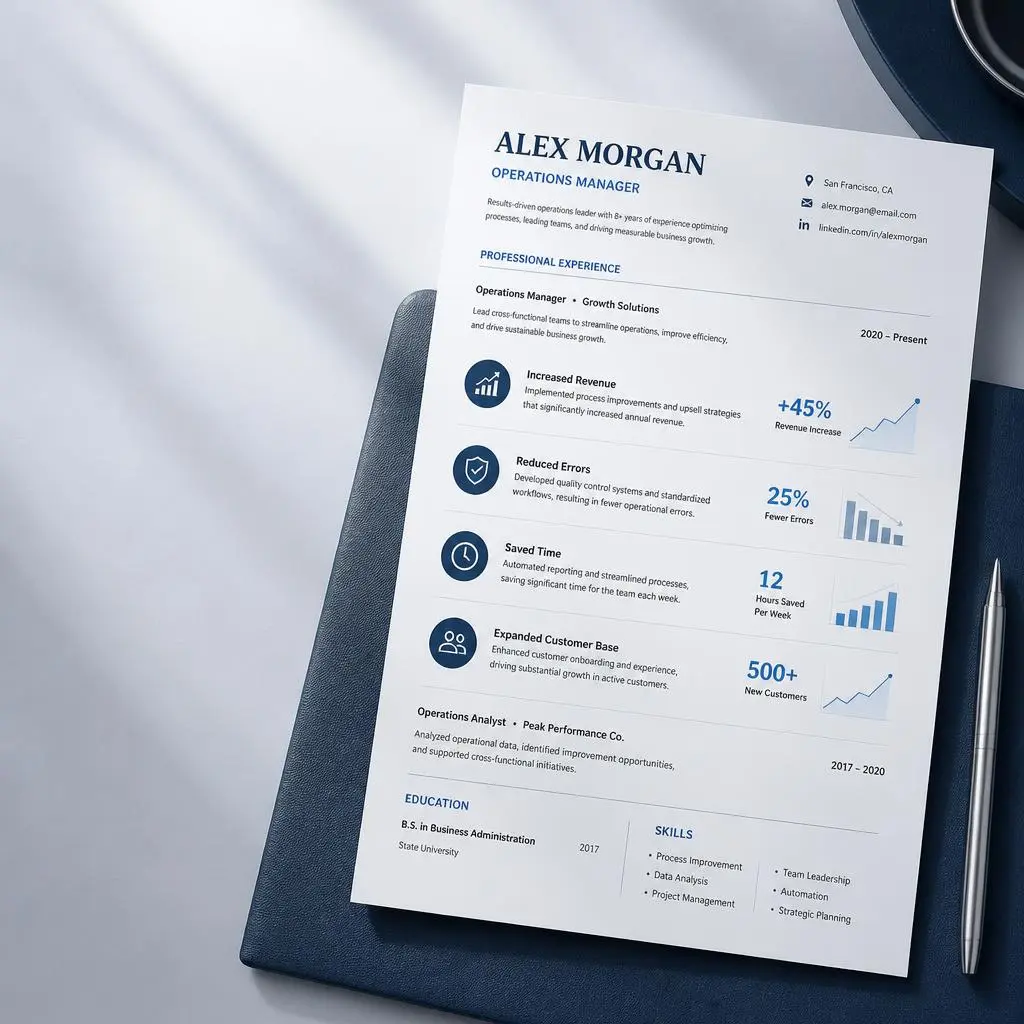
Resume Summary: How to Write a Strong Professional Profile
Recruiters rarely read a resume line by line during the first review. They scan for a few signals first: relevant experience, recognizable skills, recent results, and evidence that the candidate fits the role. That makes the opening section of your resume disproportionately important.
A professional resume summary gives the reader a quick picture of your experience, strongest skills, and the kind of results you have delivered. It should make your relevance to the specific role obvious before the recruiter moves on to the rest of the page.
What is a Professional Resume Summary? (And What It Isn’t)
A professional resume summary is typically 2–4 sentences at the very top of your resume that synthesizes your career achievements, core competencies, and unique value proposition.
Many job seekers confuse the resume summary with its traditional predecessor: the resume objective. Understanding the difference is crucial to modernizing your application.
| Feature | Traditional Resume Objective | Professional Resume Summary |
|---|---|---|
| Focus | Inward-facing (What you want from the company) | Outward-facing (What value you bring to the company) |
| Tone | Passive and generic | Action-oriented and metric-driven |
| Example | "Motivated marketing graduate seeking an entry-level position to utilize my skills and grow within a dynamic company." | "Growth marketing specialist with 4+ years of experience scaling SaaS user acquisition by 140% through data-driven SEO and paid acquisition strategies." |
An objective tends to focus on what the candidate is looking for, while a strong summary gives the employer evidence of what the candidate can bring to the role. A resume objective can still make sense in a few situations, particularly for career changers or candidates with little relevant experience, but a strong summary is usually more useful when you already have evidence of your value.
What to Include in a Resume Summary
A strong summary generally brings together a few core elements to give the hiring manager an immediate snapshot of your background:
- Professional identity: Your core role or functional title.
- Level of experience: Years in the field or seniority level.
- Area of specialization: The specific domain, stack, or industry you work within.
- Relevant skills: The tools, methods, or competencies tied directly to the target role.See our guide to resume keywords
- A meaningful achievement: A measurable result, meaningful scale, or concrete outcome that demonstrates your capability.
What to Leave Out of a Resume Summary
To keep your summary sharp and professional, avoid cluttering it with elements that belong elsewhere on your resume:
- Objective statements: What you want to get out of the job.
- Generic personality traits: Words like "hardworking," "passionate," or "dedicated."
- Salary expectations or unrelated personal details: Keep information that does not demonstrate your fit for the role out of the summary.
- Exhaustive lists of tools: Mention 2–3 core tools or technologies, not every piece of software you have ever touched.
The 3-Step Formula for a High-Impact Resume Summary
Writing a compelling summary requires structure. To write an attention-grabbing summary, use this highly repeatable three-step framework:
Target Role + Experience / Specialization + Relevant Result + Value for the Role
Step 1: Establish Your Professional Identity
Start with your professional title, years of experience, and a broad area of expertise. Be specific.
- Weak: Experienced project manager with strong communication and leadership skills.
- Strong: IT Project Manager with 7 years of experience leading software implementations for enterprise clients.
Step 2: Inject Quantifiable Evidence of Success
Follow your professional identity with evidence of what you have actually achieved. If you are in a field where numbers are harder to track, focus on scale, project complexity, or consistently delivered outcomes. This step also allows for relevant resume keywords to satisfy both automated parsing systems and human screeners.
- Example with metrics: Consistently outperformed sales quotas by an average of 115%, generating $4.2M in new business revenue over three years.
- Example without direct revenue metrics: Spearheaded the migration of legacy database architecture to AWS cloud infrastructure, reducing system downtime by 40% and saving $80k in annual licensing fees.
Step 3: Align with the Needs of the Role
End by connecting your experience to the needs of the role. Look at the job description, find their primary requirement, and address it directly. Not every achievement belongs in a summary; a 15% improvement in an internal process may be impressive in context, but if the job you're applying for is focused on customer acquisition, that number can distract from more relevant evidence.
- Weak: Looking to bring my skills to your growing team.
- Strong: Uses contract negotiation and cross-functional leadership to shorten project timelines and improve delivery.
Before-and-After Transformations
The easiest way to see the difference is to compare weak summaries with stronger versions.
1. Mid-Level Software Engineer
- The "Before" (Generic and passive):
Skilled software developer with experience in Java, Python, and SQL. Good at working in teams and solving problems. Looking for a challenging role where I can build cool applications and learn new technologies.
- The "After" (Specific and results-focused):
Full-Stack Software Engineer with 5+ years of experience designing and deploying scalable web applications in Java and Python environments. Reduced page load times by 35% after rebuilding a legacy e-commerce platform, while leading a four-person engineering team. Adept at leveraging Agile methodologies to deliver robust code architecture under tight deadlines.
2. Senior Operations Manager
- The "Before" (Fluffy and buzzword-heavy):
Results-oriented Operations Manager who is a dynamic leader and proactive problem solver. Proven track record of streamlining operations and driving efficiency across departments.
- The "After" (Specific and results-focused):
Senior Operations Manager with 12+ years of experience optimizing supply chain logistics and manufacturing workflows. Championed a Lean Six Sigma initiative that eliminated production bottlenecks, reducing operational overhead by 18%. Seeking to bring systemic efficiency improvements and cross-functional leadership to the logistics division at [Company Name].
3. Career Changer
For career changers, the summary should focus less on job titles and more on transferable skills and evidence.
- The "Before" (Confusing narrative):
High school English teacher looking to transition into corporate training and instructional design. I have great communication skills and love teaching adults.
- The "After" (Specific and results-focused):
Educator transitioning into instructional design with 7 years of experience developing comprehensive curricula and delivering structured training sessions. Built onboarding and training materials used across multiple departments, translating complex subject matter into practical learning modules.
Resume Summary Formatting Rules
- Aim for roughly 40–80 words: Keep it easy to scan. A dense paragraph is harder to read, especially when recruiters are reviewing multiple applications.
- Use active language and strong action verbs: Prefer direct verbs such as managed, built, reduced, increased, launched, led, redesigned, or automated.
- Match your story: Your resume and cover letter should tell the same story. The summary can highlight your strongest qualification, while the cover letter gives you room to explain why that experience matters for the specific role.
- Tailor it to each type of role: Start with a strong base summary, then adjust the most relevant skills, terminology, and achievements for each job posting.
How to Audit and De-Fluff Your Summary
Before submitting your resume, run your summary through this filter to replace subjective claims with concrete evidence:
| Weak phrase | Show evidence instead |
|---|---|
| "Excellent communicator" | Presented quarterly results to senior leadership |
| "Highly motivated self-starter" | Led a cross-functional team of 8 |
| "Creative thinker" | Reduced processing time by 30% |
| "Strong team player" | Caught and resolved critical bugs before launch |
Resume Summary Example Template
Use this reusable layout to draft your own summary:
[Target Role] with [X years of experience] specializing in [relevant area]. [Achievement or measurable result]. Skilled in [2–3 relevant skills], with a track record of [relevant business outcome].
A Simple Test for Your Resume Summary
Before you finalize your summary, run it through these three quick checks:
- Can I tell what role this person is targeting?
- Can I see evidence that they can do it?
- Is the experience relevant to this specific job?
If the answer to any of these is no, your summary still needs refinement. Once your summary is polished, compare it against the job description. The strongest version isn't necessarily the one with the most keywords; it's the one that makes the overlap between your experience and the role obvious.
Frequently Asked Questions
Should a resume summary include keywords?
Yes. Weaving relevant keywords from the job description into your summary can help align your resume with ATS parsing and make the most relevant qualifications easier for recruiters to spot.
Should I write my resume summary in first-person or third-person?
Write your resume summary in the implied first-person, which omits personal pronouns like "I," "me," "my," or "we."
- Correct: "Digital Marketing Manager with 6+ years of experience..."
- Incorrect (First Person): "I am a Digital Marketing Manager with..."
- Incorrect (Third Person): "John is a Digital Marketing Manager with..."
Do entry-level candidates or recent graduates need a resume summary?
Yes, but the focus shifts from years of career history to academic achievements, internships, leadership roles, and transferable skills. If you have zero professional experience in your target field, highlight your most relevant coursework, capstone projects, or transferable skill sets that align with the role.
What is the difference between a resume summary and a professional profile?
While the terms are often used interchangeably, a resume summary typically focuses on a concise paragraph of achievements and experience at the top of a standard resume. A professional profile can sometimes include a short bulleted list of core competencies alongside the narrative paragraph.
Analyze Your Resume Right Now
Use our AI to see your resume's ATS score and receive improvement suggestions
Start for Free