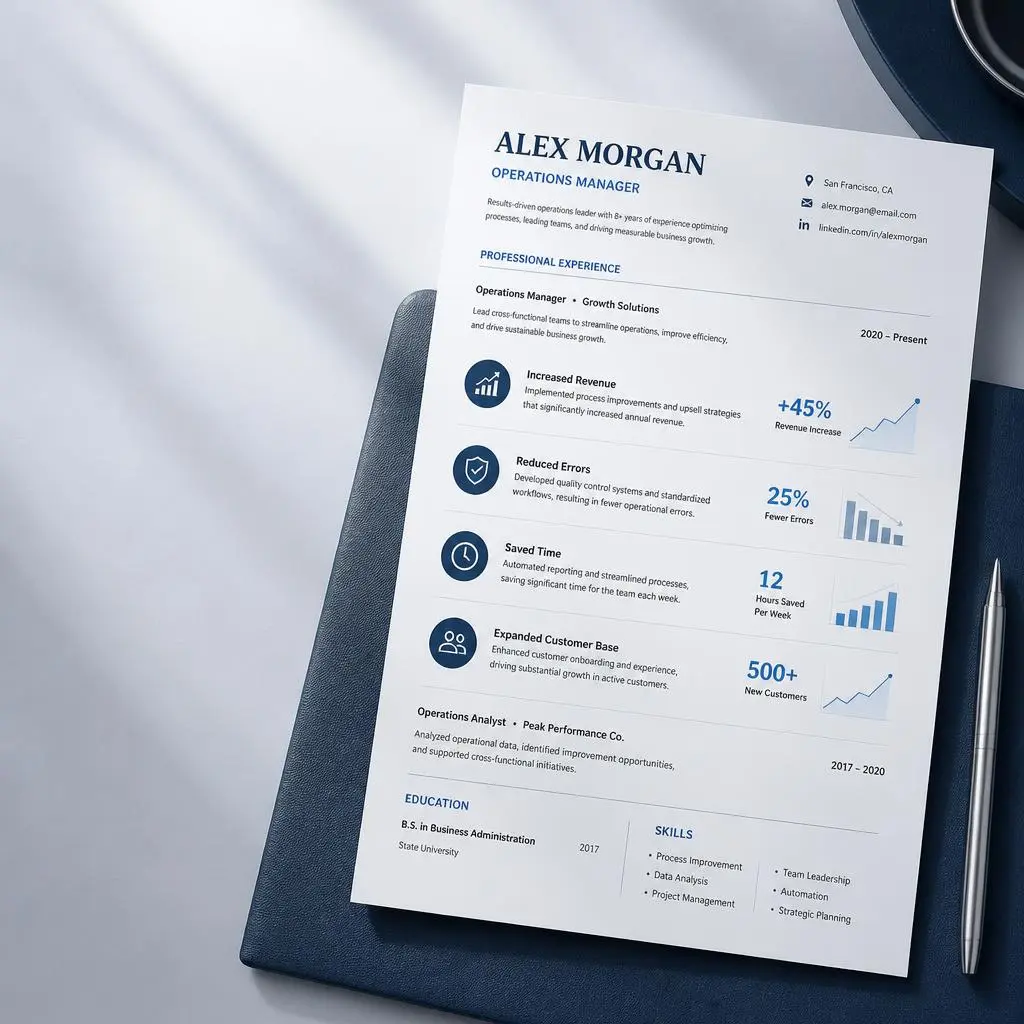
Soft Skills on a Resume: Examples and Best Practices
Most resumes lose credibility the same way: a list of soft-skill claims nobody can verify. "Excellent communicator." "Team player." "Detail-oriented." Recruiters see these phrases so often they've stopped registering as information.
Soft skills still belong on your resume. Many employers look for them alongside the technical requirements of a role. The difference between a resume that earns interviews and one that doesn't is usually whether the skills come with evidence. "Strong communication skills" is an opinion. "Ran weekly status meetings across engineering and marketing and kept a six-week launch on schedule" is communication, demonstrated.
This guide covers where soft skills belong on a resume, how to write them so they sound believable, and how to match them to the job you actually want.
What Are Soft Skills on a Resume?
Soft skills are the abilities that shape how you work: how you communicate, handle pressure, collaborate, manage your time, and make decisions. They sit alongside hard skills — the technical, teachable abilities like SQL, bookkeeping, or copyediting — and often determine how well someone applies those technical abilities in practice. A support engineer who knows the product cold but can't explain it calmly to an angry customer is only half as useful as the job requires.
In postings and resumes, they tend to cluster into four groups:
- Working with people: communication, teamwork, conflict resolution, negotiation, customer service
- Managing yourself: time management, organization, adaptability, working under pressure
- Thinking: problem-solving, critical thinking, decision-making, creativity
- Leading: delegation, coaching, stakeholder management
Job postings rarely use tidy categories. "Ability to manage competing priorities" is time management. "Comfortable presenting to senior leadership" is communication under another name. Translating the posting's phrasing into your own examples is part of tailoring a resume — more on that below.
Soft Skills vs. Hard Skills
The difference comes down to verifiability.
Hard skills are concrete and testable. You either know Python or you don't; your forklift certification is current or it isn't. A resume can state them plainly because they can be checked with a skills test, a portfolio, or a license lookup.
Soft skills are behavioral. Nobody issues a certificate for patience. The most convincing proof you have them is a record of situations where you used them, which is why they need different treatment on the page:
- Hard skills can live in a list. "Excel (pivot tables), SQL, Tableau" tells a recruiter everything they need at a glance.
- Soft skills need context. "Communication, teamwork, adaptability" tells a recruiter nothing until the experience section backs it up.
Both matter. Hard skills often establish whether you meet the technical requirements; soft skills help show how effectively you'll work with others and handle the realities of the role. That's why even solo technical roles ask for "strong collaboration" — and why the resume needs to answer that ask with more than an adjective.
Where to Include Soft Skills on Your Resume
Soft skills can appear in five places. They are not equally powerful — the further down the list, the more situational each one becomes.
1. Resume Summary
The summary is two to four lines at the top, and it's the right spot for one or two soft skills that are central to the role — phrased with specifics, not adjectives.
- Weak: "Motivated professional with excellent communication and leadership skills."
- Stronger: "Customer success manager with six years in B2B SaaS. Known for de-escalating at-risk accounts and running quarterly reviews that executives actually attend."
The second version works because "de-escalating at-risk accounts" is a claim with content, and it points the reader toward the experience section to verify it. The guide to writing a resume summary covers structure and length in detail.
2. Work Experience
This is where soft skills earn their place. Bullets that describe what you did — with scope and outcomes — are one of the strongest places on a resume to actually prove a behavioral skill. The pattern: a specific action, the situation it happened in, and a result where one exists.
- Duty: "Responsible for onboarding new team members."
- Bullet: "Onboarded six new hires over a year and built the training checklist now used for every new analyst."
Not every bullet needs a number, but a real figure makes a skill concrete in a way adjectives never will. See how to write strong resume bullet points and how to quantify achievements without inventing anything.
3. Skills Section
A skills section is fine — useful, even, as a quick index for recruiters and for keyword matching. The mistake is treating it as a soft-skill dump.
A focused list of relevant skills, mixing hard and soft and drawn from the posting, reads as targeted. A list of twenty soft skills — communication, leadership, positivity, work ethic, adaptability, and fifteen more — reads as padding, because every one of those words is free to claim.
Two rules keep it honest: only list soft skills that show up somewhere in your experience or summary, and use the posting's wording where it's accurate. If they ask for "stakeholder management" and you've done it, write "stakeholder management," not "good with people."
4. Projects
Projects give soft skills somewhere to live when your job titles don't — especially for students, career changers, freelancers, and developers.
"Led a four-person team in a 48-hour hackathon, splitting work across frontend, backend, and design and presenting the demo to a panel of judges" demonstrates leadership, delegation, and communication in two lines. Freelancers can use client work the same way: "Managed three client accounts end to end, from kickoff calls to monthly reporting."
5. Education, Volunteering, and Extracurriculars
Early in your career, these sections carry more weight than you might expect. Organizing a campus fundraiser is real experience coordinating people. Weekly tutoring shows reliability. "Volunteered at a food bank" demonstrates nothing, but "coordinated Saturday volunteer shifts for 15 people" does.
The caveat: be honest about scope. One-off participation isn't leadership, and inflated claims tend to collapse in interviews. Describe what you actually did and let the scale be what it is.
How to Show Soft Skills Instead of Just Listing Them
It's worth being precise about why a demonstrated skill beats a claimed one, because the mechanics matter when you write your own bullets.
- Claimed: "Strong leadership skills."
- Demonstrated: "Led a five-person team through a six-week product launch, coordinating deadlines across engineering, design, and marketing."
The demonstrated version gives the reader three things the claim can't:
- Evidence — a specific situation they can picture and evaluate
- Scope — a team of five, a six-week timeline, three departments
- An interview hook — they can ask what went wrong, what you'd change, what shipped
A claim invites skepticism. A specific example invites a question, and in an interview, that's exactly what you want. When a recruiter is skimming a stack of applications, interchangeable phrases blur together; specific details are what stick. If you want to know what else they're scanning for, here's how recruiters actually read resumes.
Soft Skills Resume Examples: Weak vs. Strong
The examples below cover the soft skills that come up most often in postings. None of them are meant to be copied word for word — they're patterns to adapt to work you've actually done. Where a number appears, treat it as a placeholder: a real figure from your own work beats an invented one, and if you don't have one, describe the scope instead.
Communication
Communication appears frequently in job postings, but it is also one of the vaguest soft skills on resumes. The fix is naming the audience, the format, and what the communication achieved.
- Weak: "Excellent communication skills."
- Stronger: "Presented weekly product updates to non-technical stakeholders, translating engineering blockers into decisions the team could act on."
Leadership
Relevant whenever a role involves ownership, including informal ownership of a process, tool, or timeline.
- Weak: "Natural leader."
- Stronger: "Led a five-person team through a six-week website relaunch, setting deadlines across design, content, and development."
Teamwork and Collaboration
Postings dress this up in many ways — "cross-functional partner," "collaborative mindset" — but the evidence looks the same: work that other people's work depended on.
- Weak: "Team player."
- Stronger: "Worked with sales and product to trace recurring customer complaints to a billing error and redesign the escalation process."
Problem-Solving
Strongest for operational, analytical, and technical roles, where the posting usually hints at the kind of problems you'd own.
- Weak: "Strong problem-solving abilities."
- Stronger: "Investigated recurring order-processing errors, traced them to a manual data-entry step, and rebuilt the workflow, cutting corrections by roughly 30%."
Adaptability
Matters most in fast-changing environments: startups, reorganizations, roles spanning multiple systems.
- Weak: "Adaptable and flexible."
- Stronger: "Covered two vacant roles for three months during a team restructure, keeping client deliverables on schedule and documenting processes for the incoming hires."
Conflict Resolution
Directly relevant for management, HR, support, and account roles — anywhere tension is part of the job.
- Weak: "Skilled at conflict resolution."
- Stronger: "Mediated a scheduling dispute between warehouse and delivery teams that had been delaying shipments, then set up a shared calendar both sides accepted."
Attention to Detail
Especially valued in finance, QA, editorial, and compliance work. "Detail-oriented" is one of the most common phrases in resumes, which is exactly why it needs evidence.
- Weak: "Detail-oriented."
- Stronger: "Reconciled monthly inventory counts across three warehouses and resolved discrepancies before every reporting deadline."
Customer Service
For any role where you're the face of the company: support, retail, hospitality, account management.
- Weak: "Great with customers."
- Stronger: "Handled 50+ customer calls a day across billing and technical queues, de-escalating disputes and flagging recurring issues to the product team."
The remaining skills follow the same logic. A compact reference:
| Skill | Weak | Stronger |
|---|---|---|
| Stakeholder management | "Comfortable managing stakeholders." | "Kept marketing, legal, and finance aligned on a launch, running biweekly check-ins and renegotiating scope when compliance requirements shifted." |
| Time management | "Good time management." | "Managed 12–15 concurrent client accounts, flagging at-risk deadlines to leads a week ahead." |
| Decision-making | "Sound decision-maker." | "Compared three suppliers on cost and reliability and recommended a switch that ended the recurring delivery delays." |
| Negotiation | "Strong negotiator." | "Negotiated renewal terms with three top suppliers, holding price increases to 2% against a requested 7%." |
| Active listening | "Good listener." | "Ran monthly one-on-ones with a support team of eight and turned recurring agent feedback into two workflow changes." |
| Critical thinking | "Critical thinker." | "Audited two years of campaign data before a platform renewal and found most spend sitting in channels with no measurable conversions." |
| Creativity | "Creative thinker." | "Pitched a low-budget win-back email series that recovered 60 lapsed accounts in its first month." |
| Emotional intelligence | "High EQ." | "Rebalanced workloads across a 12-person team after one-on-ones flagged burnout risk, ahead of the busiest quarter of the year." |
| Organization | "Highly organized." | "Built a shared intake tracker for a five-designer team, replacing scattered email requests so briefs stopped falling through the cracks." |
Adapt, don't copy. A bullet only works if it describes something you genuinely did — at your scale, in your industry, with your results.
How to Add Soft Skills to Resume Bullet Points
A reliable structure for experience bullets: action + context + result. The soft skill should surface through the verb and the situation, not through a label.
Take this line:
"Presented monthly performance reports to senior stakeholders, turning complex data into concise recommendations that fed quarterly planning."
The skill — communicating analysis to non-experts — is never named, but the example makes it clear. "Presented" sets the action, "monthly" and "senior stakeholders" give the scale, and the result shows the communication had consequences. Compare that to "strong written and verbal communication," which asks the reader to take your word for it.
Two things to watch:
- Not every bullet needs all three parts, and not every bullet needs a number. A resume where every line ends in a percentage starts to sound manufactured. Mix proof-of-skill bullets with plain responsibility bullets when the duty itself is the evidence.
- Skill-signal verbs do a lot of quiet work: mediated, negotiated, translated, coordinated, trained, de-escalated, aligned. Choosing the right verb often means you never have to name the skill at all.
How to Match Soft Skills to a Job Description
The fastest way to choose the right soft skills is to read the posting as a spec rather than an ad. They show up in four places:
- Explicit requirements: "strong written and verbal communication"
- Repeated phrases: the same trait mentioned in two or three bullets
- Responsibilities that imply them: "own escalations end to end" implies conflict resolution and follow-through
- Context clues: "fast-paced startup" suggests adaptability; "global team" suggests cross-cultural communication
Here's a short excerpt from a (fictional) customer success posting:
- Own a portfolio of ~40 mid-market accounts as the primary point of contact
- Run quarterly business reviews with customer executives
- De-escalate at-risk accounts and coordinate internal teams to resolve issues
- Highly organized, comfortable managing competing priorities
Reading it as a spec:
- "Primary point of contact," "de-escalate at-risk accounts" → conflict resolution, staying calm under pressure
- "Quarterly business reviews with executives" → stakeholder management, presenting
- "Coordinate internal teams" → cross-functional collaboration
- "~40 accounts," "competing priorities" → organization, time management
You wouldn't claim all four clusters. Pick the two or three you can back hardest and write experience bullets that prove them:
"Managed a portfolio of 40 mid-market accounts, running quarterly reviews with customer executives and coordinating support, product, and billing to resolve escalations before accounts went at-risk."
One bullet, four skills from the posting, zero adjective claims.
One warning: don't mirror phrases you can't support. Claiming "comfortable presenting to C-level audiences" when you've presented to your own team twice will surface fast in an interview. And if a posting emphasizes a skill you genuinely lack, treat that as information about fit — not a wording problem to write around.
Our guide to matching your resume to a job description breaks this process down further, and the keyword extractor pulls the recurring terms from any posting you paste in.
Soft Skills and ATS
Applicant tracking systems don't evaluate soft skills the way humans do. Many parse the resume into structured data and, depending on the hiring workflow, may match or rank it against the job description. Two implications:
The posting's terminology matters. If a system or recruiter search is looking for "stakeholder management" and your resume says "good with people," you may not match, even if you've done exactly that work. Where the posting's phrase is accurate for you, use it.
Keywords alone prove nothing. Cramming "communication communication communication" into a resume doesn't demonstrate communication, and the human who eventually reads it will notice. The goal is matching terms, not maximizing them.
Practical setup:
- Put your strongest relevant soft skills in the skills section, in the posting's words.
- Support them in experience bullets, where both keyword matching and human readers find evidence.
- Keep formatting simple — standard headings, no text boxes or graphics — so the parser can read the whole document. This guide to ATS-friendly resume formatting covers the details.
If you want to check how your resume survives parsing, the ATS format checker flags structural issues, and the resume keywords guide goes deeper on matching terminology.
Soft Skills for Different Candidates
Entry-Level Candidates and Students
You prove soft skills with whatever you've actually done:
- Coursework: a group project where you coordinated the split and hit the deadline
- Part-time work: retail shifts demonstrate customer service and reliability; a restaurant rush is time management under pressure
- Clubs and societies: treasurer means organization; events roles mean planning and coordination
- Volunteering: a regular commitment shows reliability; organizing anything shows initiative
Be precise about your role. "Group project" demonstrates nothing. "Coordinated the four-person team for a semester-long statistics project, scheduling check-ins and delivering the final report on time" demonstrates several things at once.
Candidates With No Professional Experience
Everything above applies, with more weight on academic, volunteer, and personal projects. Don't invent jobs, and don't inflate one-off participation into ongoing responsibility. The guide to writing a resume with no experience covers the full structure.
Career Changers
Soft skills are often a career changer's strongest transferable asset, because they travel between industries more cleanly than tools do. A teacher moving into corporate training doesn't need to explain the curriculum software — but "designed and delivered 200+ lessons to classes of 30, adapting material for mixed skill levels" is the new job, almost word for word.
Translate your old industry's evidence into the new one's vocabulary, and put that translation in the summary so recruiters see the fit immediately. More in the career change resume guide.
Experienced Professionals
The risk at senior levels is the opposite: generic soft-skill claims that make ten years of experience read like one. "Excellent communicator" on a director's resume says nothing; "negotiated a two-year vendor contract covering three business units" says a great deal.
Emphasize scope and consequence — teams led, budgets owned, stakeholders managed, decisions made and what came of them. The soft skills should be visible in the size of the problems, not stated next to them.
How Many Soft Skills Should You Include?
There's no universal number, and anyone selling one is guessing. A few realistic guidelines:
- Skills section: keep the list focused, mixing hard and soft skills that are relevant to the role. Every slot spent on an irrelevant soft skill is a slot not spent on something the hiring manager is scanning for.
- Relevance beats quantity. Three soft skills that match the posting outperform twelve that don't.
- Depth over width. Your two or three most important soft skills for this role should also appear — demonstrated, not just named — in the summary or experience.
A quick test: if you can't connect a skill on your list to something specific you've done, cut it.
Common Mistakes
- A skills section of 20+ soft skills. Reads as padding and dilutes the skills that matter.
- Claims with no support. If "conflict resolution" appears in the skills section but nowhere else, it's decoration.
- Copying posting phrases you can't back up. Mirrored keywords without matching evidence often fall apart in interviews.
- Concentrating soft skills in the skills section only while experience bullets stay duty-based. The skills section is the index; experience is the proof.
- Buzzwords without evidence. "Results-driven professional" describes every applicant alive.
- Ignoring the posting and sending the same generic list everywhere.
- Irrelevant skills. "Creativity" on a compliance resume where the posting never hints at it.
- Repetition. Six bullets in a row starting with "collaborated."
- Vague character claims. "Hard worker" needs evidence like any other skill.
- Inconsistency. Claiming "detail-oriented" on a resume with typos undermines itself.
The fuller list lives in our guide to common resume mistakes.
Soft Skills That Are Often Overused
None of these phrases are forbidden. The problem is that they've appeared on so many resumes, unsupported, that they no longer carry information. Each can work — if evidence sits nearby.
| Phrase | Why it falls flat | What to write instead |
|---|---|---|
| Hard worker | Everyone claims it | A time you carried extra load: "Covered two roles for three months during a reorg" |
| Team player | Says nothing about how | "Worked with sales and product to fix the escalation process" |
| Go-getter | Vague and dated | A project you initiated and its outcome |
| Results-driven | Unverifiable adjective | A result: "Cut onboarding time from six weeks to three" |
| Detail-oriented | Extremely common, easily contradicted | An error you caught, a process you kept clean |
| Excellent communicator | The vaguest claim on any resume | Audience + format + outcome |
| Fast learner | Assertion, not evidence | "Learned the reporting stack in a month and was running weekly reports by week six" |
Notice the pattern in the right-hand column: every replacement is a story compressed into a line. That's the whole technique. If you suspect your draft leans on filler, the buzzword checker flags the phrases recruiters have learned to skip.
How to Make Soft Skills Credible
Before sending, audit every soft skill against this list. A skill is credible when the resume contains at least one piece of real evidence:
- A project you completed, and your role in it
- A problem you solved, and how
- A team you coordinated, with its size
- A stakeholder group you managed or reported to
- Customers you supported, at what volume
- A process you improved
- A conflict you resolved
- A deadline or target met under real constraints
- A decision you made, and what came of it
If a skill appears only in the skills section with no evidence anywhere else, add evidence or cut it.
One thing worth saying plainly: the evidence has to be true. Every specific you add gives an interviewer something to ask about, and soft-skill stories unravel quickly under "walk me through that." Specific and true beats impressive and shaky.
The resume itself is evidence too. A clean, well-organized, typo-free document demonstrates organization and attention to detail before you claim either.
Frequently Asked Questions
What are the best soft skills to put on a resume?
The ones the posting asks for, filtered against what you can prove. Communication, teamwork, problem-solving, and adaptability are common examples, but "best" always means "best for this job." A claims adjuster's resume needs different soft skills than a community manager's.
Should I list soft skills in the skills section at all?
Yes, as a brief index: a handful of items, mixed with hard skills, written in the posting's language where it's accurate, and backed up somewhere else on the resume. The list helps scanning and keyword matching; it doesn't replace demonstration.
How do I show soft skills instead of just listing them?
Put them in experience bullets as actions with context and, where possible, results. "Mediated" shows conflict resolution. "Presented to senior stakeholders" shows communication. The verb does the claiming for you.
Can soft skills help with ATS screening?
Indirectly, yes. Some systems and recruiter searches match on keywords, so using the posting's terminology where it's accurate can help you match. But keywords don't substitute for evidence, and a human still reads the resume before an interview happens.
What soft skills matter most on an entry-level resume?
Reliability, communication, customer service, and willingness to learn — the things a hiring manager can't assume about a candidate with a short work history. Part-time jobs, group projects, and volunteering all supply evidence.
How do I prove soft skills with no work experience?
Use coursework, group projects, volunteering, clubs, and informal work. Precision is what makes them count: "organized weekly volunteer schedules for 12 people" is evidence; "volunteered at a charity" is not.
The Takeaway
Pick one job posting. Identify the three to five soft skills it emphasizes. Find the moments in your own history where you actually used them — a project, a conflict, a deadline, a decision. Write those moments as bullets with action, context, and outcome. List the skills briefly in the skills section, in the posting's language, and cut everything you can't support.
That's the whole method. A resume full of demonstrated soft skills beats one full of claimed ones for a simple reason: it gives the reader something to believe instead of something to doubt.
Analyze Your Resume Right Now
Use our AI to see your resume's ATS score and receive improvement suggestions
Start for Free